
I thought I’d take a slow couple of weeks after the release of Quadrant Modulator.
It didn’t really work out that way.
The idea was to spend some time making videos, playing guitar and preparing all the material for this launch. My guitar playing hasn’t improved, but I got a lot of other stuff done. More on that later.
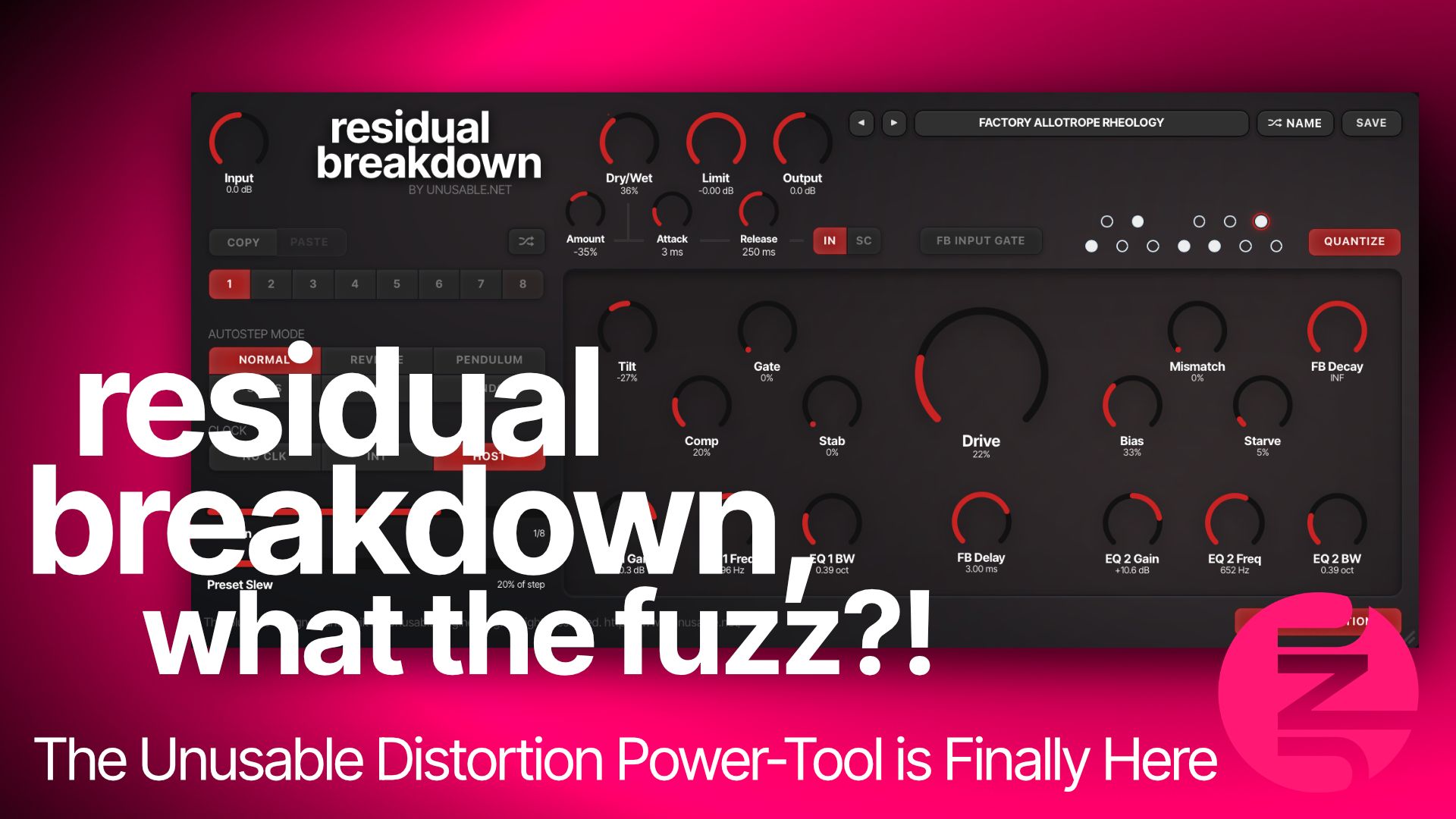
Residual Breakdown
Residual Breakdown is based on a three-transistor fuzz circuit that I eventually gave up trying to model accurately. Instead, I kept tuning it until it got me on my toes.
That is usually how I decide if something is good enough. If I can’t get down on my heels while playing with it, that is the mark.
As it often does, the plugin grew a bit in features and complexity, but I think it ended up as a very unique distortion.
The original circuit is known for its uncontrollable self-oscillation, and that is still one of the main features of Residual Breakdown.
In the end I decided to make it possible to turn the self-oscillation off too. It is cool with it on, but being able to disable it gives the plugin a much wider usable range.
Well. It is still a brutal distortion even at the lowest settings, so the last sentence should probably be taken with a grain of salt.
The signal path is a bit more complex than the original circuit too, and the slot sequencer is the same slightly more capable version I used in Quadrant Modulator.
I drew a quick diagram of the signal path:
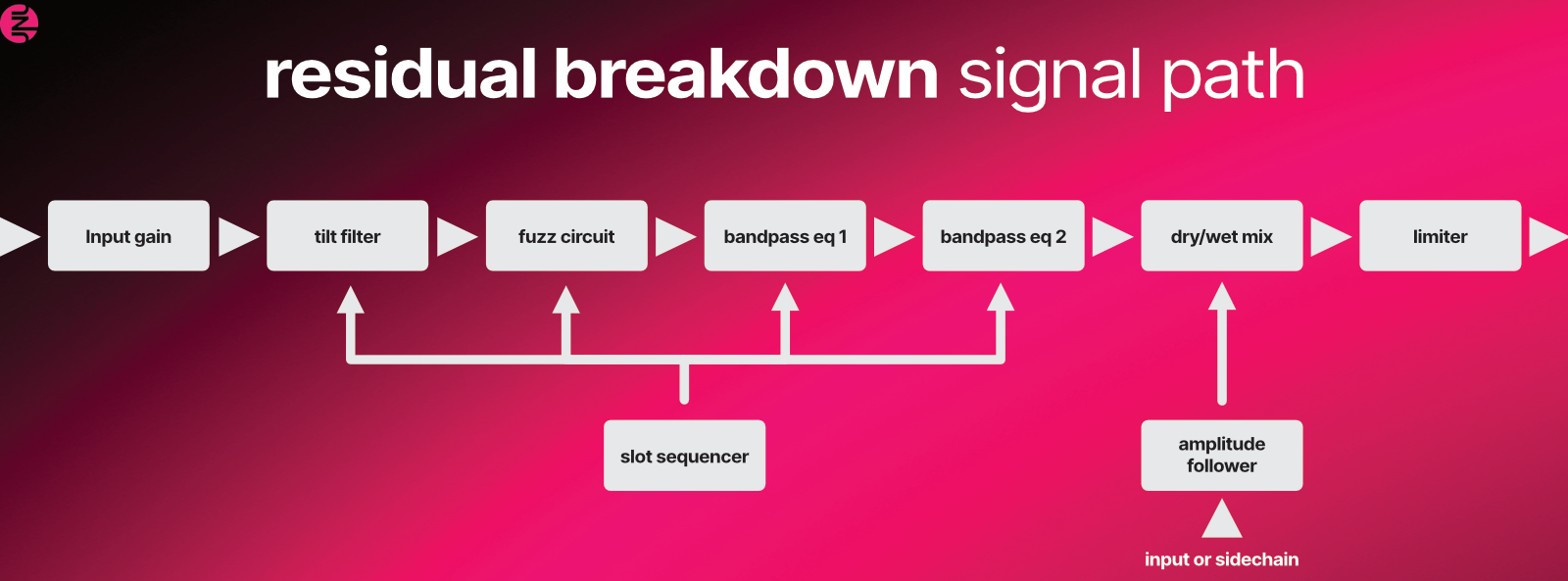
The first control is Input Gain.
That control is available in most of my plugins for gain staging and for driving the processing harder, but it is even more important here since the circuit simulation reacts a lot to the incoming level.
After that we enter the slot-controlled part.
First there is a simple Tilt EQ to skew the spectrum before the fuzz circuit.
With self-oscillation active, there are a few controls specifically related to that, although the oscillation itself comes from how the fuzz controls interact.
The sound then goes through two parametric EQ bands before leaving the slot-controlled section.
Next is Dry/Wet, joined by an envelope follower that can follow either the input or a sidechain signal.
Finally there is the output stage with a tube-like limiter similar to the one in Quadrant Modulator.
So the signal path grew a bit more complex than my original intention, but I think it made it a much better plugin.
Self-oscillation
I couldn’t leave that part as it was either.
The unstable and semi-controllable behavior is fun, but I wanted something that could be a bit more musical while still being surprising.
So I added the possibility to quantize the self-oscillation to selected pitch maps, with MTS-ESP support.
The feedback can therefore play its own notes together with the input, in the same scale.
Combined with the slot sequencer, you can make the self-oscillation move through different states and play melodies together with the source material.
So, if your life is lacking distortion, Residual Breakdown is here to make amends.
If you own Full Suite v2 or Emulated Effects, it has already been added to your account:
https://www.unusable.net/account/
For everyone else, it is €29 incl. 25% VAT.
The product page with user guide and videos is here:
Partials & Discrepancies 1.4.0
I decided to use Partials & Discrepancies as scaffolding for my next synthesizer project.
The story behind that synth goes back something like eleven years.
At the time I was deeply into electronic circuit design and Eurorack. I had optimized my work enough that probably 70–80% of my workdays were spent in SPICE and KiCad.
I actually had a complete module range ready in case I ever wanted a change of career.
Well, I did change career, but went deeper into web and software development instead. Those modules are still sitting around as finished prototypes that will probably never go into production.
I really like simple synths.
My left-hand synth in the studio right now is the Prophet-5. Its simplicity is elegant, and I can play a basic patch for a long time because the oscillators have a full and drifting sound that feels alive.
The Moog Muse has some of the same thing, but it also has enough options that it is easy to get stuck making complex patches instead of just playing.
For the new synth I wanted to make a straightforward subtractive synth with that kind of simplicity. The key for me is a good oscillator pair.
My personal preference leans toward my Minimoog, Cwejman S1, Moog Muse and Prophet-5.
I remembered that one of my old Eurorack modules used a saw-core oscillator that had some of the core sound I wanted.
So I dug up the old KiCad schematics and converted them for LTSpice.
The simulation worked pretty well, including some of the wonky waveform shapes in the waveshapers, so I converted the mathematical model into C++.
Well, a bit too many parts really.
I included my not-so-fancy exponential converter too, which meant that the first version of the new plugin could only track about three octaves decently.
I have sorted that out now, and most of the synth is working roughly how I want it.
During that work I also started expanding the preset system, which has been one of those projects I have postponed for some time.
That is actually why I am writing about all of this here. I decided to go back to Partials & Discrepancies and implement the extended preset system there too.
Extended preset system
Partials & Discrepancies is now at 1.4.0.
The preset browser now has sorting, category and type filtering, and metadata that can be populated both automatically and manually.
I have also added 24 new factory presets.
The downloadable APD bank on the product page now has bank metadata too, so grab it again if you want it to show up as a separate bank in the preset browser.
I will make a video later on how to create your own banks.
If you already know JSON, here is the quick version: open a preset in a text editor and it should be quite obvious. After saving the change, click the Refresh icon in the preset browser and the new bank should become available both as a filtering option and as a metadata option.
Oscillator to Filter FM
There is also one new sound feature.
The additive oscillator can now FM the filter, and the amount is stored in the slot sequencer.
So the FM amount can change and slew together with the other slot settings.
There are also a few smaller bug fixes in 1.4.0.
A few smaller updates
Geometry Delay, Geometry Reverb, Binaural Modulator and Entropy Encoder have also had some smaller updates and bug fixes.
Some of those have been available for a while, but I haven’t made any notifications about them.
So if you use those plugins and haven’t updated recently, it might be worth grabbing the latest versions.
Geometry Delay got another small fix just now too.
What next?
The coming time will mainly be focused on polishing the new synth, Currents & Nostalgia, and trying to figure out how to do a proper product launch for it.
I won’t stress this one out of the door.
It has a more common synth architecture in many ways, which also means it is entering a more crowded market.
I still believe it has its own thing going on, and personally I find it a joy to play.
Tomorrow is my birthday, and I’ll cry if I want to.
But I won’t, as I am having too much fun with this synth.
All the best,
Rasmus Nyåker