

A fairly big update this time.
Windows versions of all plugins are now available, all plugins are updated to v1.1.3, and there is also a new plugin out in the Scientist series: Synaptic Resonance.
And since I apparently do not know how to do one thing at a time, there is also a small teaser for the next synth at the bottom.
Windows versions
I am happy to say that Windows versions of all plugins are now available.
If you already own one or more of my products, the Windows versions are available through your account page. The same license works on both Mac and Windows.
This has been quite a bit of work, mostly because I had used a few very Mac-only ways of solving things, and I did not want to maintain separate codebases for Mac and Windows. That work also led to a round of smaller updates across the whole lineup. Nothing major in the DSP, but general stability improvements and smaller bug fixes.
So all plugins are now updated to version 1.1.3, which is also the initial Windows version.
I have tested the plugins extensively in multiple hosts on both Windows 10 and Windows 11. They may or may not work on Windows 7, but I will not offer any official support for that, especially as the plugin interfaces rely on a third-party solution that no longer supports Windows 7.
A new plugin in the Scientist series: Synaptic Resonance
The last couple of weeks have been fairly intense, mostly jumping between the Windows work and the coming synth Partials & Discrepancies.
So to relax a bit, I went digging through old files.
I found a neural simulation I had built quite some time ago and decided to dust it off and turn it into an audio plugin using my current framework. I explored a few more fancy phase-distortion directions with it first, before settling on making something that, in my opinion, just sounds great: a vocoder-like filter bank.
So I ended up building what can probably best be described as a neural vocoder.
The simulation is a 2-dimensional lattice of neurons connected by synapses. Like nerve cells, each cell reacts to chemical and electrical change and keeps trying to find a balance it cannot really achieve. This lattice is stimulated by an incoming audio signal split into 40 steep bands in a musical spread. The signal can come either from the input or from a sidechain input.
Those bands are placed along a plane that can be moved, rotated, and modulated across the lattice. The signal excites the neurons. Another plane then reads the lattice back in a similar way.
If you use a sidechain signal and place the planes close together at the same rotation, you get a nice-sounding vocoder. It also looks very fancy, uses a lot of CPU, and is, in the end, quite a wasteful and beautiful way to take a detour toward a very familiar effect.
As you rotate the planes and move them apart, the synapses and neurons become much more audible. They start acting and reacting more on their own, and sometimes it sounds like alien languages are getting introduced into the signal.
A full walkthrough of Synaptic Resonance with sound examples.
If you own Scientist Suite or Full Suite, the plugin is already available to you for both Mac and Windows, completely free.
It is also available individually for 29 euro including 25% VAT, and it is now included in both of those bundles, with no price increase.
A teaser: Partials & Discrepancies
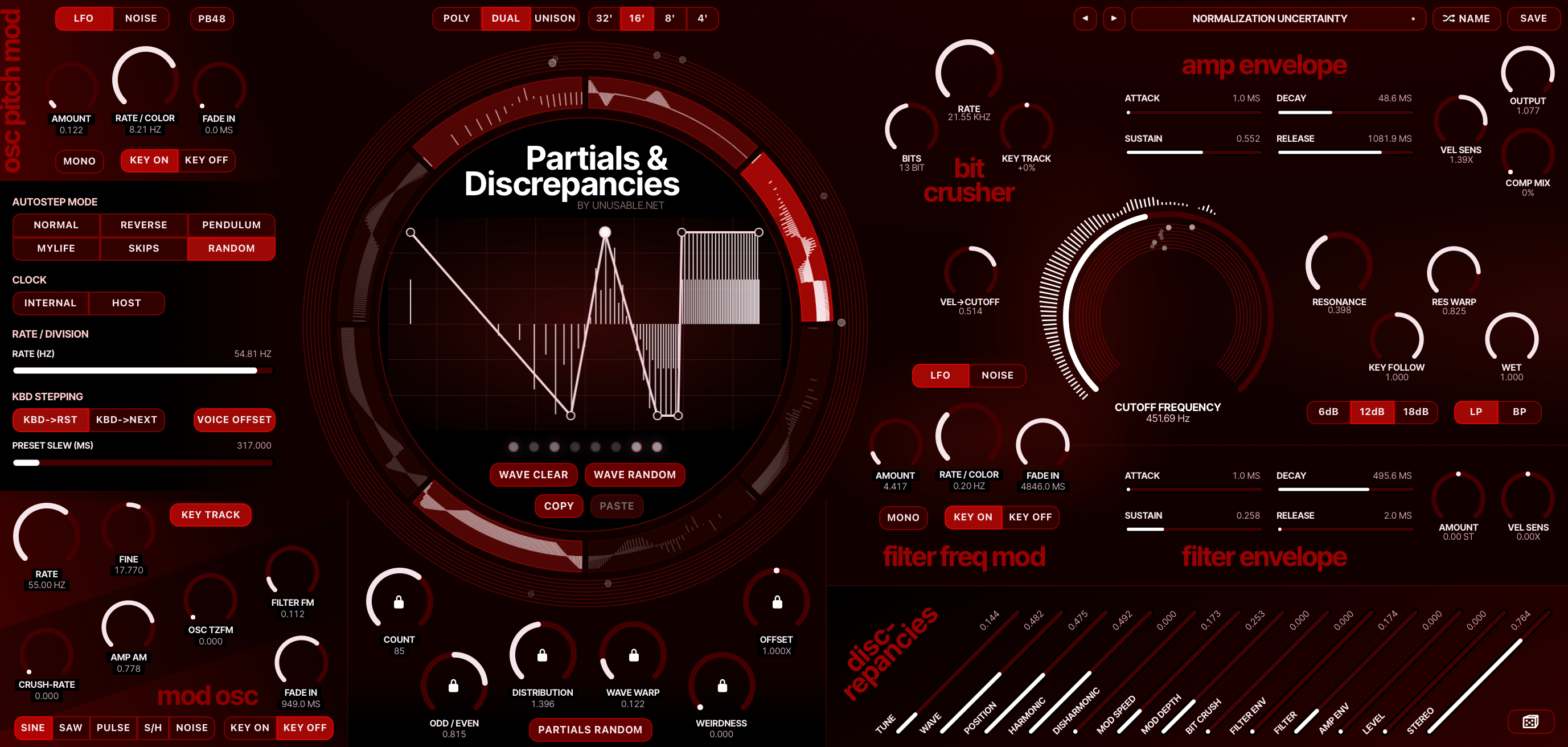
I have also been working on the next synth: Partials & Discrepancies.
It is an 8-voice additive polysynth with up to 128 sine partials per voice.
It is a sibling of Curves & Membranes in some ways, but its opposite in many others. It can move from harmonic and simple sounds into complete dissonance and chaos, and then back again. It is not as immediate as C&M, but I think I have managed to make a polysynth where you can actually read and follow what all the voices are doing. It also has a few more alternative implementations that make it feel fun and refreshing, while still being much closer to synthesizer heritage than some of my other work.
The main thing I wanted was to make additive synthesis available through a more usable abstraction layer. For me personally, that part is working. It is quick and fun to work with, but still wide and surprising sound-wise.
Development-wise it is stable. What I need to spend time on now is building good starting-point presets, and presets that actually show off the more unique parts of it properly. After focusing so much on Windows support and infrastructure, I am honestly looking forward to spending more time in the studio with that part.
I will not give any ETA on it yet. I think it will probably end up a bit more expensive than Curves & Membranes, likely around 79 euro. But everyone who already owns Curves & Membranes, either standalone or as part of a Suite, will get a much better crossgrade price.
Thanks for all the support, and for all the emails and messages. It has genuinely been a joy running this business so far.
All the best,
Rasmus Nyåker